Reading Diagrams
Reading diagrams can sometimes be a little tricky. On this page, I explain how to read the different types of diagrams used in patterns from Knitting Stuff.
Unless otherwise stated in the pattern, the following generally applies:
Diagrams are worked either back and forth or in the round.
The numbers on the diagram indicate which row or round you are working, as well as which direction you should read the diagram.
The row or round should be worked from the side where the number is shown. For example, if the number is on the right-hand side, work the row from right to left.
If the number is on the right-hand side, the row is worked on the right side.
If the number is on the left-hand side, the row is worked on the wrong side.
In some cases, there are no numbers on the diagram. This is usually a general diagram that should be adapted depending on where you are in your knitting.
Knitting in the Round
When knitting in the round using a diagram, all rounds are worked on either the right side or the wrong side. The numbers are placed on the same side of the diagram, which means that all rounds are read in the same direction.
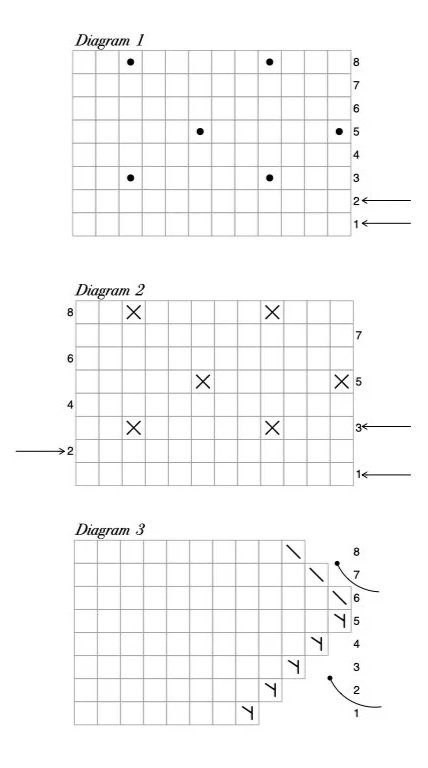
Example – Diagram 1:
In Diagram 1, all rounds are worked on the right side. Round 1 is worked from right to left, and for the next round, you start at the far right of the row above. The diagram is therefore read from right to left, from the bottom up.
Knitting Back and Forth
When knitting back and forth using a diagram, you turn your work instead of knitting in the round. This means that, for example, one row is worked from the right side and the following row from the wrong side.
Example – Diagram 2:
In Diagram 2, you work Row 1 from right to left on the right side. For Row 2, you work from the side where the number 2 is shown, meaning you work Row 2 from left to right.
The diagram is therefore read from the bottom up, back and forth, starting from right to left.
No Stitch
Sometimes there is no square in a row or column of the diagram. This means that there is either no stitch there, or that the stitch should simply not be worked. See Diagram 3.